
The 1989 Lincoln cent represents a common coin found in daily pocket change today.
The United States Mint produced this coin in huge numbers with a core made of zinc.
These coins often show signs of wear after thirty-six years of circulation because a very thin layer of copper covers them and affects the 1989 Penny value.
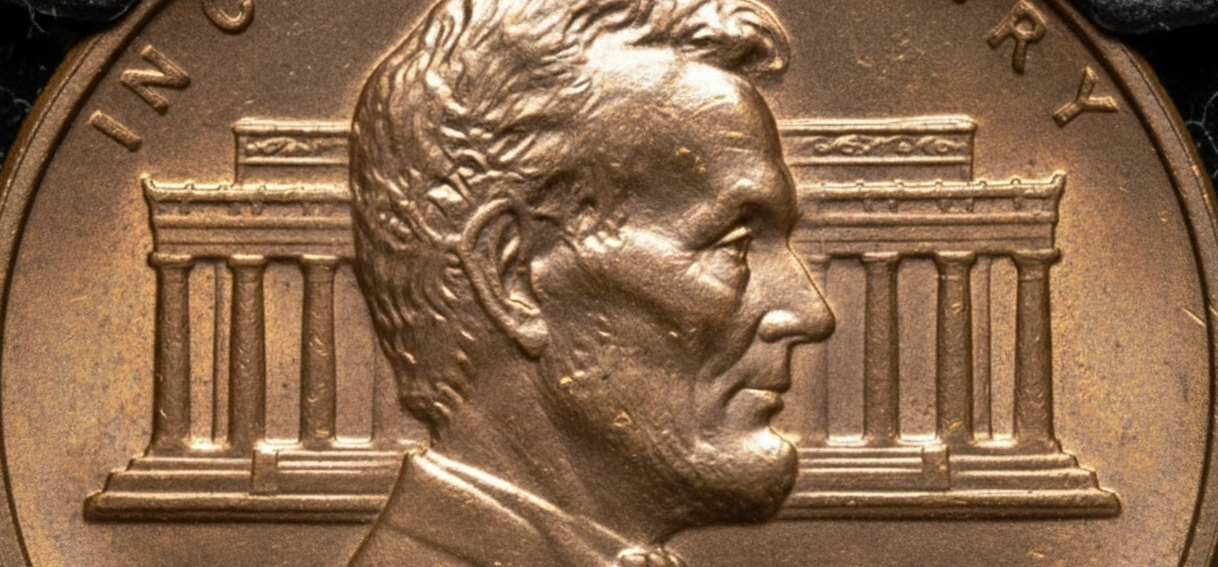
Feature | Description |
Composition | 97.5% Zinc, 2.5% Copper |
Weight | 2.50 grams |
Diameter | 19.05 mm |
Designer | Victor David Brenner (Obverse), Frank Gasparro (Reverse) |
Edge | Plain |
Production Numbers and Mint Marks
The Philadelphia Mint produced 7,261,285,596 pennies in 1989.
These coins lack a mint mark and are very easy to find in modern circulation.
A regular 1989 penny stays worth exactly one cent because it has such a high mintage.
Workers at the Denver Mint produced 5,345,467,111 coins marked with a small "D".
The "D" penny is also extremely common and is found mostly in the western part of the United States.
The total production exceeds twelve billion coins when we compare these two mints.
The Mint ensures that finding a standard 1989 penny remains simple by creating so many items.
People usually look for "uncirculated" versions kept in original rolls when they invest in these coins.
These uncirculated coins attract the most attention from buyers because they preserve the original red color.
We find proof coins made for collectors at the San Francisco Mint.
These coins bear the "S" mint mark and never entered general circulation.
The Mint created high-quality versions with shiny surfaces and produced only 3,220,101 proof sets.
Valuation of Standard 1989 Pennies in 2025
Evaluating a coin depends mostly on its physical condition and color.
Coins receive a number from 1 to 70 after professional services grade them.
A low-grade penny shows many scratches and remains worth its face value of $0.01.
High-grade coins reach much higher prices when they maintain a bright red appearance.
We see a steady interest in MS68 (Mint State 68) coins in the 2025 market.
Grade | 1989 (No Mint Mark) | 1989-D | 1989-S (Proof) |
Circulated | $0.01 | $0.01 | N/A |
MS65 (Red) | $1.00 - $3.00 | $1.00 - $3.00 | N/A |
MS67 (Red) | $15.00 - $25.00 | $12.00 - $20.00 | N/A |
MS68 (Red) | $150.00 - $300.00 | $100.00 - $250.00 | N/A |
PR69 (Deep Cameo) | N/A | N/A | $5.00 - $10.00 |
PR70 (Deep Cameo) | N/A | N/A | $45.00 - $70.00 |
Significant Auction Records and Price Trends
We find very high prices for coins in perfect condition when we study past sales.
A 1989 penny graded MS69 Red reached a record price in 2018 and sold for $7,050.
MS69 represents a coin with almost no visible marks under a microscope and is a rare grade.
A 1989-D penny in MS68 Red sold for $420 in a recent auction.
The value for MS67 coins increases by approximately 5% every year, according to price data.
Collectors buy these high grades as long-term investments and hope for a big profit.
The price growth remains stable but slow when we compare the 1989 penny to earlier years.
The market demands full red (RD) color, and the value decreases by 10% for brown or red-brown coins.
A penny loses its premium price quickly if it loses its copper shine.
Owners spend money on professional grading to confirm the high quality of their finds.
Top 3 Auction Records for 1989 Cents
1989 No Mint Mark (MS69 Red): Sold for $7,050 (Heritage Auctions).
1989-D (MS69 Red): Sold for over $500 (Multiple sales).
1989-S (PR70 Deep Cameo): Sold for $518 (Legacy collections).
Identifying Rare 1989 Penny Errors
Collectors look for mistakes made during the minting process when they search for errors.
A person can turn one cent into hundreds of dollars if they find an error penny.
You can spot these specific issues on the coin's surface by using a coin value checker app.
Doubled Die Reverse (DDR)
Doubling becomes visible when the die hits the coin twice at a slightly different angle.
You might see thicker letters if you focus on the words "ONE CENT" or "UNITED STATES OF AMERICA".
These coins attract significant interest because they display clear doubling.
A nice 1989 DDR penny remains a popular find and sells for $50 to $100.
Off-Center Strikes
The design appears moved to one side when the coin blank sits incorrectly in the machine.
A coin looks very strange and valuable because it shows only 50% of the design.
The coin loses value if it lacks a full date, so finding the year "1989" is important.
Off-center errors are rare and desirable, so they increase in price by 15% annually.
A 50% off-center 1989 penny can sell for $75 to $150, depending on the quality.
Repunched Mint Mark (RPM)
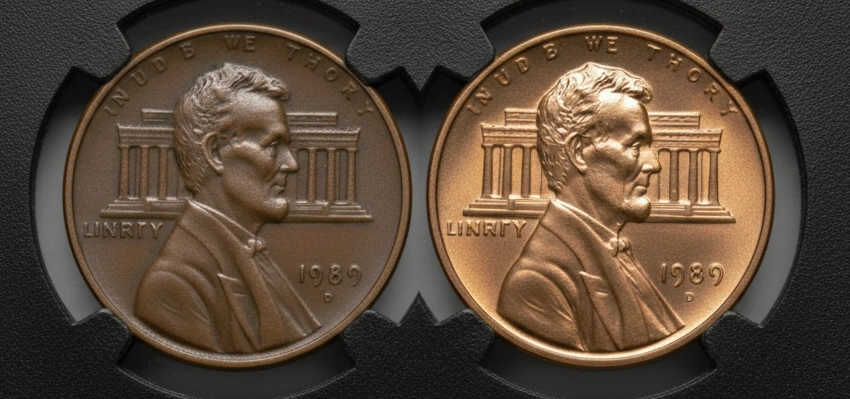
You might see one "D" stamped over another when you check the "D" on the 1989-D penny with the coin identifier app.
This error is common but collectible and was created by a worker hitting the letter punch twice.
A collector might pay $10 to $25 for a sharp example of an RPM coin.
Die Cracks and Chips
Small lines of raised metal appear on the coin as a result of old or damaged tools.
These are minor errors and are commonly found on Lincoln's head or around the letters.
Die cracks are good for beginner collectors and sell for a few dollars.
How to Handle and Protect Your 1989 Pennies
You must avoid touching the surface with your fingers when you find a shiny 1989 penny.
Your skin can cause dark spots over time because it leaves oils on the metal.
You preserve the original condition by holding the coin by its edges.
You protect the coin from air and moisture when you place it in a plastic holder.
Storage is critical since we see the price of copper-plated zinc coins drop due to "zinc rot".
The zinc core reacts with the environment and develops small white bubbles.
A coin with zinc rot is ruined forever and loses 100% of its collector value.
You ensure the coins remain dry by checking your collection every few months.