
Two identical years can hide very different coins.
Commemorative 1976 quarter projects reached their historical peak during the 1975–1976 period at the US Mint.
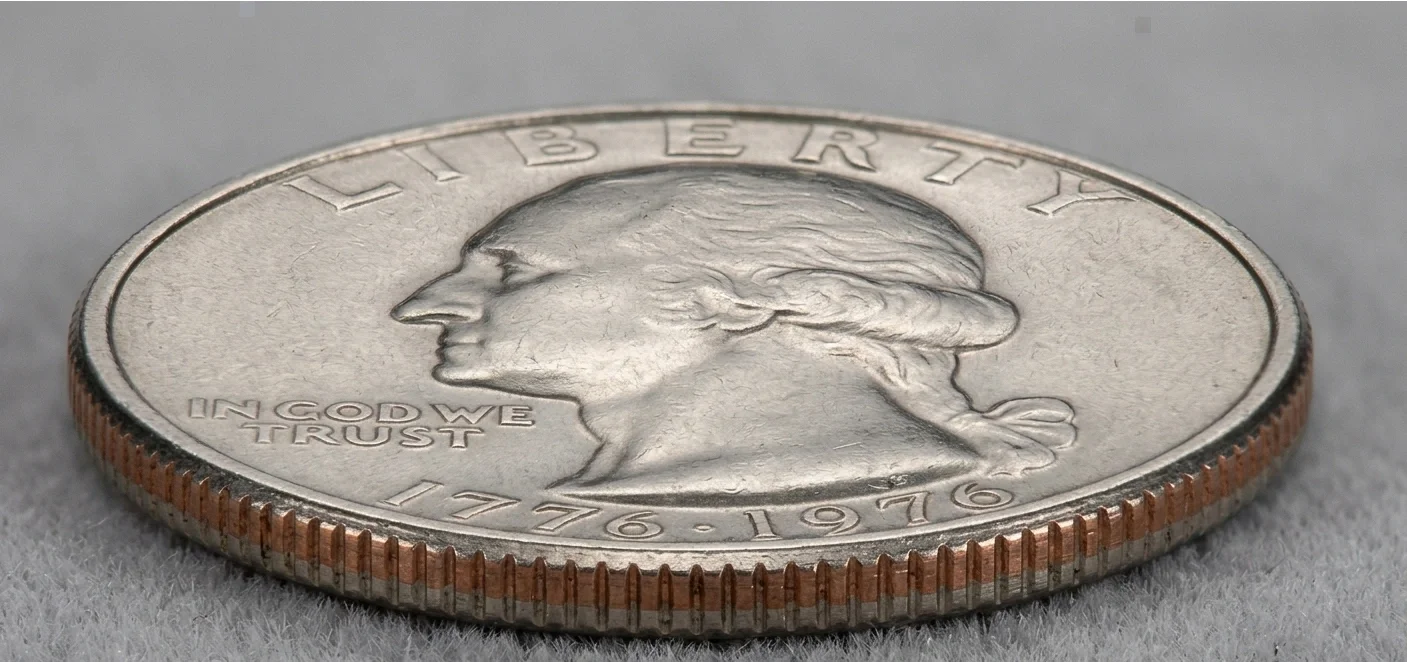
Dual dates on the obverse unite two coin types possessing fundamentally different physical properties.
Identifying the metal and determining the preservation state directly dictate the market price of a specimen.
Technical Feature | Clad Quarter | Silver Quarter |
Surface Material | 75% Copper, 25% Nickel | 80% Silver, 20% Copper |
Core Material | 100% Copper | 21% Silver, 79% Copper |
Total Mass | 5.67 grams | 5.75 grams |
Pure Silver Content | 0.00 grams | 2.30 grams |
Edge Thickness | 1.75 mm | 1.75 mm |
Material Density | 8.92 g/cm³ | 9.53 g/cm³ |
A mass difference of 0.08 grams allows for primary separation without using chemicals.
Visual inspection of the edge reveals the presence or absence of a red Copper layer.
Production Statistics and Rarity Probability
Three minting facilities provided the numismatic market with an oversupply of specimens.
Total mintage volume exceeded 1.6 billion units.
Minting structure by location:
Philadelphia (No mark): 809,784,016 units
Denver (D mark): 860,118,839 units
San Francisco (S mark, Copper-Nickel Proof): 7,053,992 units
San Francisco (S mark, Silver Proof): 4,000,000 units
San Francisco (S mark, Silver Uncirculated): 11,000,000 units
High production density in Philadelphia and Denver → Die wear → Reduced relief quality.
Finding coins in MS68 condition or higher becomes difficult due to damage during bag transport.
Bag marks cause contact hits, lowering potential grades to MS64.
Pricing Dynamics and 2026 Auction Statistics
Market value for 1776–1976 coins follows a strict gradation based on preservation.
Objective data from auction houses confirms exponential price growth when moving from MS67 to MS68.
Copper-Nickel Coin Values (Denver):
MS65 Condition: $12
MS66 Condition: $28
MS67 Condition: $420
MS68 Condition: $2,900
Record Price: $6,462
Price dynamics for top grades over the last 5 years:
2022: +8% → 2023: +12% → 2024: +5% → 2025: +15%
Silver Coin Values (San Francisco):
MS67 Condition: $22
MS68 Condition: $85
MS69 Condition: $2,550
Record Price: $19,200
Investment appeal for Silver coins in MS69 condition results from their low numbers in PCGS registries.
Dropping interest in grades below MS65 leads to sales near face value or metal weight.
Identifying Valuable Varieties and Manufacturing Errors
Manufacturing errors create the most expensive positions in the 1976 quarter segment.
Lacking quality control during peak loads led to the appearance of unique specimens.
List of confirmed defects:
Doubled Die Obverse (DDO): Shows doubling in the word LIBERTY and date digits
Struck on Silver blank without S mark: Officially unconfirmed but remains a target for searches
Missing S mark on Proof coins: One of the rarest technical mistakes
Cladding error: Missing Nickel layer on one or both sides
Struck on 10-cent blanks: Results in clipping parts of the legend
Detecting a Doubled Die Obverse on a high-grade coin instantly raises the price to $800–$1,200.
Every find requires mandatory verification by a professional grading service.
Low percentage of genuine errors → Abundance of fakes created mechanically.
Physical Properties and Identification Methods
Owners must sequentially perform a series of checks to exclude mistakes.
Determining genuine Silver composition requires using precise tools.
Home verification algorithm:
Weighing on jewelry scales: A mass of 5.75 grams indicates Silver.
Sound test: Silver coins emit a clear, long ring when lightly tapped.
Edge check: Absence of a red Copper stripe supports Silver layering.
Magnet test: Silver and Copper-Nickel alloys should not be attracted to magnets.
Or simply use the free coin scanner app.
Using chemical reagents is prohibited.
Chemical impact → Surface structure damage → Loss of numismatic value.
Professional dealers use X-ray fluorescence analysis for non-destructive composition control.
Grading and Surface Evaluation Criteria
Sheldon’s 70-point scale standards remains the foundation for price determination.
Visual characteristics in 2026 are analyzed using AI algorithms.
Key control zones:
Washington's cheek: Most prominent part, subject to wear first.
Coin fields: Presence of small scratches or hairlines lowers the score.
Drummer relief: Clarity of the sticks and costume details on the reverse.
Mint luster: Intensity of light reflection from the surface.
Specimens with deep mirror fields are classified as Prooflike.
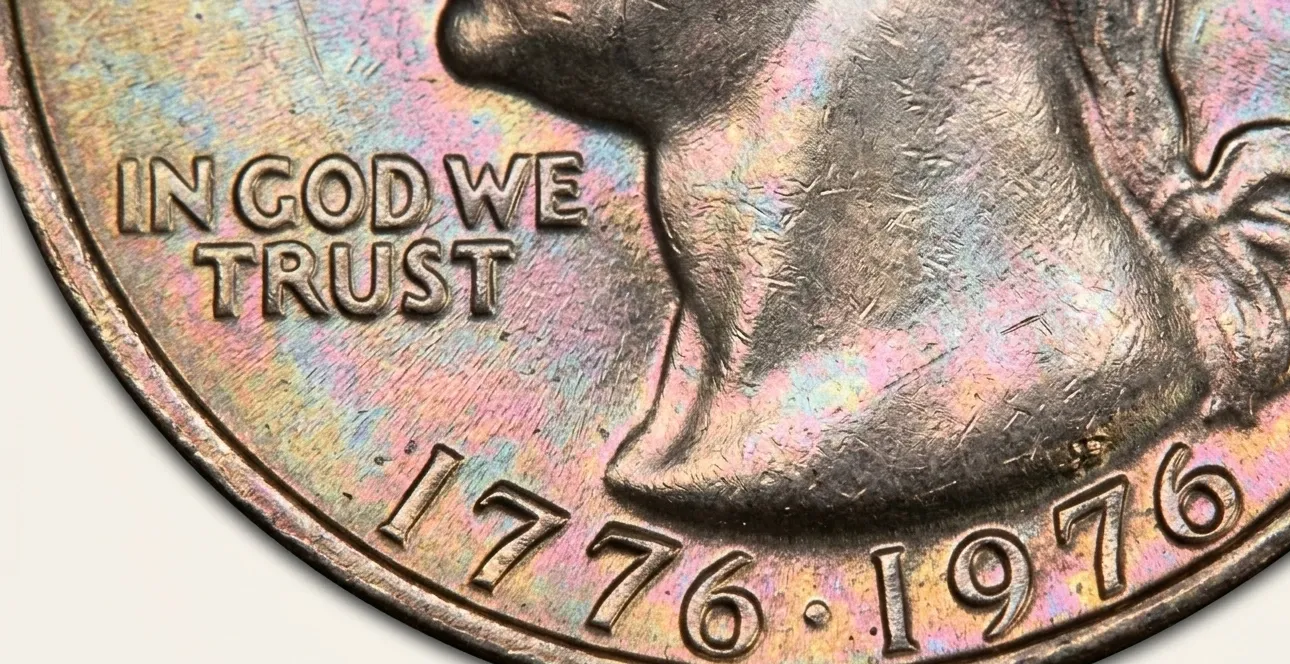
Patina on Silver coins can either raise or lower the price.
Rainbow patina → Value growth of 20–50%.
Dark spotted patina → Reduced appeal for most buyers.
US Commemorative Market Dynamics
Quarters from 1776–1976 are among the most recognizable numismatic objects worldwide.
Jack Lühr’s design provided the coin with long-term cultural status.
Investment Risk Comparison:
Clad MS65 coins: High risk due to massive supply.
Silver MS69 coins: Low risk thanks to stable demand.
Minting errors: Medium risk, depends on authenticity confirmation.
Statistics show that top-grade coins appreciate by an average of 6.5% annually.
Inflationary processes in 2024–2025 pushed precious metal prices upward.
Silver price within the coin is approximately $2.10 at current rates.
Numismatic premiums in top grades exceed metal value by hundreds of times.
Preservation and Degradation Prevention
Metals used in 1976 minting are sensitive to environmental conditions.
Nickel and Silver react with sulfur and moisture.
Collection conservation rules:
Using inert plastic capsules without PVC content.
Storing at a constant temperature of 18–22 degrees Celsius.
Relative air humidity should not exceed 35%.
Excluding direct hand contact with the coin surface.
Fingerprints → Oxidation → Permanent stains on the field.
Using cotton gloves is a mandatory standard of work.
Professional slabs (hermetic cases) provide the best protection for decades.
Role of the San Francisco Mint
The S mint mark serves as a marker of special striking quality.
Production from this facility targets the collector market exclusively.
Two versions of the S-mark issue:
Proof: Mirror field and matte relief.
Uncirculated: Matte luster across the entire surface.
A Silver proof mintage of 4,000,000 units seems large, but less than 5% survived in perfect condition.
Many sets were opened, and coins damaged due to careless handling.
Original 1976 packaging adds $5–$10 to the total lot value.
Individual certification of each coin from a set is justified only for potential MS68+ grades.
Comparative Analysis with Other Quarters
In 2026, investors often compare the 1976 issue with the "Statehood" or "Beautiful America" series.
Bicentennial quarters win due to the historical significance of the event.
Liquidity parameters:
Sale time for MS67 coins: 2 to 5 days.
Sale time for rare mint errors: 1 month (via auction).
Buy-sell spread: 15–20% for certified specimens.
Liquidity for ungraded coins approaches zero.
Secondary market buyers prefer overpaying for a guarantee of authenticity.
PCGS and NGC registries allow for checking a specific coin's history online.
Final Checklist for Coin Owners
Owners must structure information before making selling or appraisal decisions.
Analytical objectivity ensures capital preservation.
Appraisal stages:
Date check: Only 1776–1976.
Mint mark check: None, D, or S.
Metal determination: Scales and visual edge inspection.
Use the best coin identifier app
Preservation check: Searching for scratches and wear under magnification.
Variety search: Comparing inscriptions with Doubled Die standards.
Circulated coins with heavy damage are worth 25 cents.
Coins in perfect condition require immediate encapsulation.
Fact-based knowledge protects against unjustified expectations and fraud.
The 1976 quarter story continues in digital registries and private safes.
Value for this coin truly goes far beyond just the date on the obverse.